
Info Session: Planned Student Project Exhibition (USA at 250) 🗓

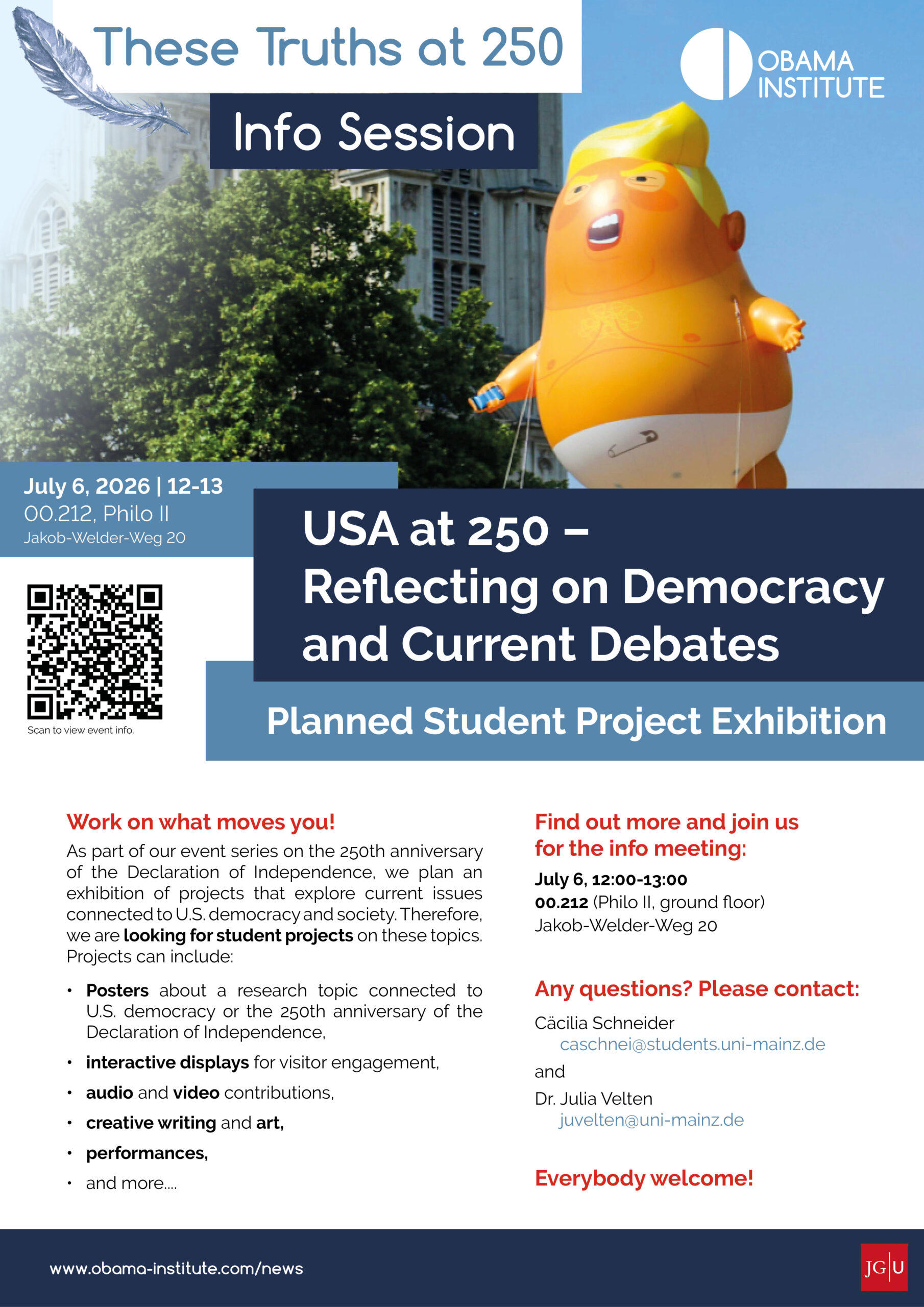
Info Session: Planned Student Project Exhibition (USA at 250) 🗓

USA at 250 – Reflecting on Democracy and Current Debates

Info Session for Planned Student Project Exhibition

July 6, 12:00-13:00
00.212 (Philo II, ground floor)
Jakob-Welder-Weg 20

Work on what moves you!

As part of our event series on the 250th anniversary of the Declaration of Independence, we plan an exhibition of projects that explore current issues connected to U.S. democracy and society. Therefore, we are looking for student projects on these topics. Projects can include:

  • Posters about a research topic connected to U.S. democracy or the 250th anniversary of the Declaration of Independence,
  • interactive displays for visitor engagement,
  • audio and video contributions,
  • creative writing and art,
  • performances,
  • and more….

Find out more and join us for the info meeting:

July 6, 12:00-13:00
00.212 (Philo II, ground floor)
Jakob-Welder-Weg 20

Any questions? Please contact:

Cäcilia Schneider
caschnei@students.uni-mainz.de
and
Dr. Julia Velten
juvelten@uni-mainz.de

Everybody welcome!

You can download the flyer here or by clicking on the image below.
July 4 – Guest Lecture: Indigenous Scholarship and Its Responses to ‘America250’ 🗓

July 4 – Guest Lecture: Indigenous Scholarship and Its Responses to ‘America250’ 🗓

Guest Lecture by Christianna Stavroudis (University of Wuppertal)

Indigenous Scholarship and Its Responses to ‘America250’

July 4, 2026, 09:00 a.m., P 110, Philosophicum

Events like the 1893 Columbian Exposition and the 1976 U.S. Bicentennial illustrate how Indigenous leaders, artists, and scholars have used the United States’ commemorative anniversaries across the centuries as occasions for truth telling, generating new knowledge, and networking with one another. The United States Semiquincentennial and its America250 initiatives offer a unique opportunity for scholars of Indigenous Studies to examine how Native Nations are choosing to (not) engage with this platform in expressing the history and culture of their People and the policies and goals of their Tribal governments. In this session, we will look at how Native people and Native Nations have and have not been involved in individual state and federal America250 initiatives, and at Native-led commemorations taking place this year, such as the 150th anniversary of the Battle of the Greasy Grass/Battle of the Little Bighorn.

Christianna Stavroudis is an instructor at the Department of English and American Studies at the University of Wuppertal. Her article, “‘Let My People Have a Right’: The Native Activism of Arapaho Chief Paul Boynton,” was published in the Fall 2025 issue of The Chronicles of Oklahoma. She and Gordon Yellowman, Sr. (Cheyenne Peace Chief and Tribal Historian of the Cheyenne and Arapaho Tribes) gave their presentation, “A Milestone for the Peyote Road: The 1918 Chartering of the Native American Church of Oklahoma and Its Impact on Native Nations Today,” at the 2026 Oklahoma History Symposium this May. Stavroudis and Yellowman’s latest project is entitled “Native Chroniclers and Journalists at the Turn of the 20th Century: A Case Study of Early Cheyenne and Arapaho Archival Activism,” which highlights anglophone writing published by Cheyenne and Arapaho writers in regional newspapers and boarding school press from 1875-1925.

You can download the poster for the event here.

June 2 – Guest Lecture: DNA, Family Secrets, and the Stories We Inherit 🗓

June 2 – Guest Lecture: DNA, Family Secrets, and the Stories We Inherit 🗓

Guest Lecture by Helga Lenart-Cheng (Saint Mary’s College of California, USA)

DNA, Family Secrets, and the Stories We Inherit

June 2, 2026, 16.15-17.45, 01-618 (kl. Bibl.), Philosophicum

This talk examines how genetic genealogy platforms and public media reshape the stories Americans tell about identity, family, and race. Focusing on the PBS series Finding Your Roots, it explores how DNA, archives, and television narrative turn biological data into autobiographical meaning.

Helga Lenart-Cheng (PhD, Harvard University) is Professor at Saint Mary’s College of California. Her research focuses on life writing, genetic genealogy, algorithmic storytelling, critical media studies, memory, and digital archives. She is the author and editor of several books, most recently Story Revolutions (2022) and Life Writing as World Literature (2025).

You can download the poster for the event here.

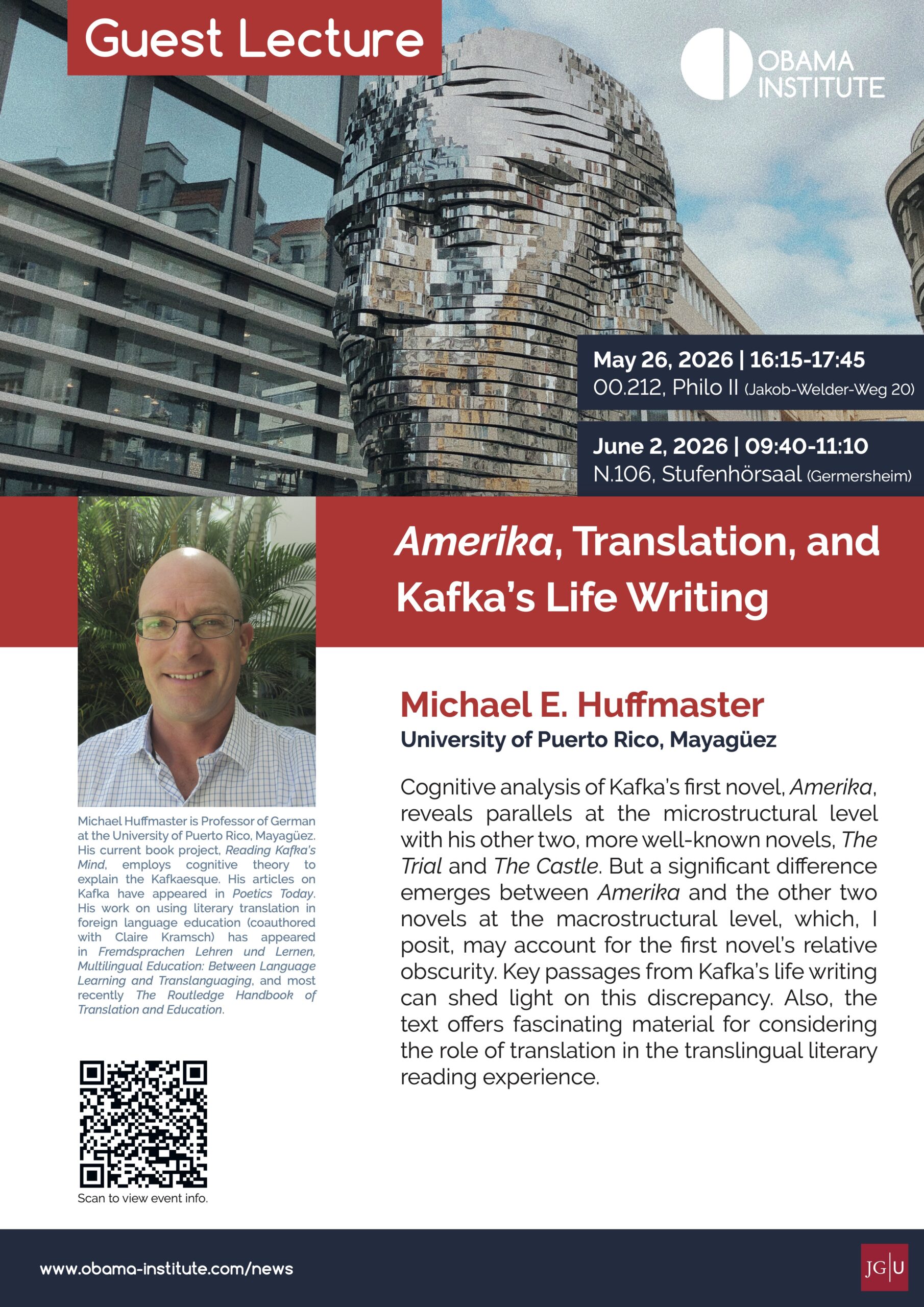
May 26 & June 2 – Guest Lecture: AMERIKA, Translation, and Kafka’s Life Writing 🗓

May 26 & June 2 – Guest Lecture: AMERIKA, Translation, and Kafka’s Life Writing 🗓

Guest Lecture by Michael E. Huffmaster (University of Puerto Rico, Mayagüez)

Amerika, Translation, and Kafka’s Life Writing

May 26, 2026, 4.15-5.45 pm, 00.212, Philo II (Jakob-Welder-Weg 20)

June 2, 2026, 9.40-11.10 am, N.106, Stufenhörsaal (Campus Germersheim)


Cognitive analysis of Kafka’s first novel, Amerika, reveals parallels at the microstructural level with his other two, more well-known novels, The Trial and The Castle. But a significant difference emerges between Amerika and the other two novels at the macrostructural level, which, I posit, may account for the first novel’s relative obscurity. Key passages from Kafka’s life writing can shed light on this discrepancy. Also, the text offers fascinating material for considering the role of translation in the translingual literary reading experience.

Michael Huffmaster is Professor of German at the University of Puerto Rico, Mayagüez. His current book project, Reading Kafka’s Mind, employs cognitive theory to explain the Kafkaesque. His articles on Kafka have appeared in Poetics Today. His work on using literary translation in foreign language education (coauthored with Claire Kramsch) has appeared in Fremdsprachen Lehren und Lernen, Multilingual Education: Between Language Learning and Translanguaging, and most recently The Routledge Handbook of Translation and Education.

You can download the poster for the event here.

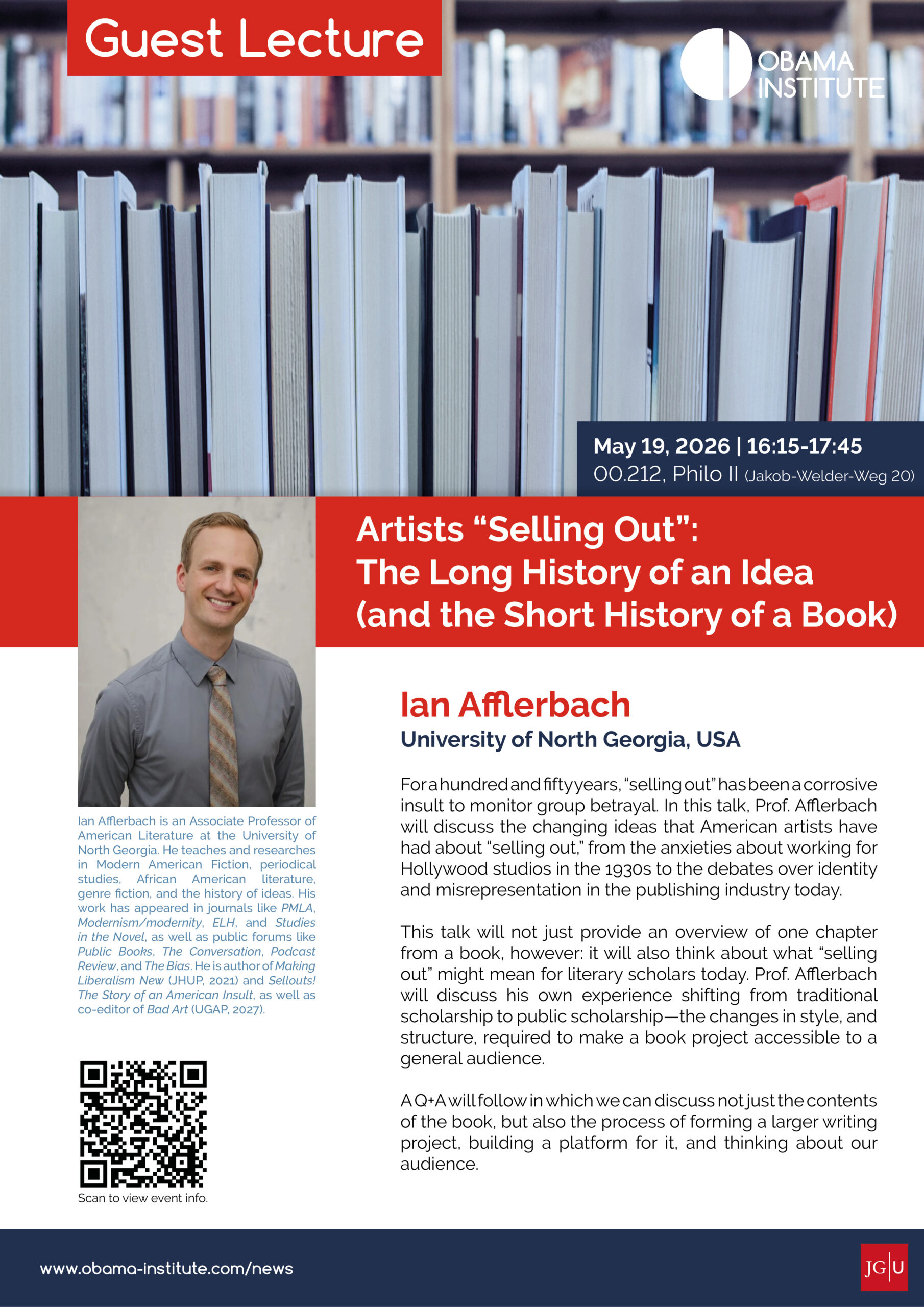
May 19 – Guest Lecture: Artists “Selling Out” The Long History of an Idea (and the Short History of a Book) 🗓

May 19 – Guest Lecture: Artists “Selling Out” The Long History of an Idea (and the Short History of a Book) 🗓

Guest Lecture by Ian Afflerbach (University of North Georgia, USA)

Artists “Selling Out” The Long History of an Idea (and the Short History of a Book)

May 19, 2026, 4.15-5.45 pm, 00.212, Philo II (Jakob-Welder-Weg 20)

For a hundred and fifty years, “selling out” has been a corrosive insult to monitor group betrayal. In this talk, Prof. Afflerbach will discuss the changing ideas that American artists have had about “selling out,” from the anxieties about working for Hollywood studios in the 1930s to the debates over identity and misrepresentation in the publishing industry today.

This talk will not just provide an overview of one chapter from a book, however: it will also think about what “selling out” might mean for literary scholars today. Prof. Afflerbach will discuss his own experience shifting from traditional scholarship to public scholarship—the changes in style, and structure, required to make a book project accessible to a general audience.

A Q+A will follow in which we can discuss not just the contents of the book, but also the process of forming a larger writing project, building a platform for it, and thinking about our audience.


Ian Afflerbach
is an Associate Professor of American Literature at the University of North Georgia. He teaches and researches in Modern American Fiction, periodical studies, African American literature, genre fiction, and the history of ideas. His work has appeared in journals like PMLA, Modernism/modernity, ELH, and Studies in the Novel, as well as public forums like Public Books, The Conversation, Podcast Review, and The Bias. He is author of Making Liberalism New (JHUP, 2021) and Sellouts! The Story of an American Insult, as well as co-editor of Bad Art (UGAP, 2027).

You can download the poster for the event here.