

July 4 – Guest Lecture: Indigenous Scholarship and Its Responses to ‘America250’ 🗓

July 4 – Guest Lecture: Indigenous Scholarship and Its Responses to ‘America250’ 🗓

Guest Lecture by Christianna Stavroudis (University of Wuppertal)

Indigenous Scholarship and Its Responses to ‘America250’

July 4, 2026, 09:00 a.m., P 110, Philosophicum

Events like the 1893 Columbian Exposition and the 1976 U.S. Bicentennial illustrate how Indigenous leaders, artists, and scholars have used the United States’ commemorative anniversaries across the centuries as occasions for truth telling, generating new knowledge, and networking with one another. The United States Semiquincentennial and its America250 initiatives offer a unique opportunity for scholars of Indigenous Studies to examine how Native Nations are choosing to (not) engage with this platform in expressing the history and culture of their People and the policies and goals of their Tribal governments. In this session, we will look at how Native people and Native Nations have and have not been involved in individual state and federal America250 initiatives, and at Native-led commemorations taking place this year, such as the 150th anniversary of the Battle of the Greasy Grass/Battle of the Little Bighorn.

Christianna Stavroudis is an instructor at the Department of English and American Studies at the University of Wuppertal. Her article, “‘Let My People Have a Right’: The Native Activism of Arapaho Chief Paul Boynton,” was published in the Fall 2025 issue of The Chronicles of Oklahoma. She and Gordon Yellowman, Sr. (Cheyenne Peace Chief and Tribal Historian of the Cheyenne and Arapaho Tribes) gave their presentation, “A Milestone for the Peyote Road: The 1918 Chartering of the Native American Church of Oklahoma and Its Impact on Native Nations Today,” at the 2026 Oklahoma History Symposium this May. Stavroudis and Yellowman’s latest project is entitled “Native Chroniclers and Journalists at the Turn of the 20th Century: A Case Study of Early Cheyenne and Arapaho Archival Activism,” which highlights anglophone writing published by Cheyenne and Arapaho writers in regional newspapers and boarding school press from 1875-1925.

You can download the poster for the event here.

June 2 – Guest Lecture: DNA, Family Secrets, and the Stories We Inherit 🗓

June 2 – Guest Lecture: DNA, Family Secrets, and the Stories We Inherit 🗓

Guest Lecture by Helga Lenart-Cheng (Saint Mary’s College of California, USA)

DNA, Family Secrets, and the Stories We Inherit

June 2, 2026, 16.15-17.45, 01-618 (kl. Bibl.), Philosophicum

This talk examines how genetic genealogy platforms and public media reshape the stories Americans tell about identity, family, and race. Focusing on the PBS series Finding Your Roots, it explores how DNA, archives, and television narrative turn biological data into autobiographical meaning.

Helga Lenart-Cheng (PhD, Harvard University) is Professor at Saint Mary’s College of California. Her research focuses on life writing, genetic genealogy, algorithmic storytelling, critical media studies, memory, and digital archives. She is the author and editor of several books, most recently Story Revolutions (2022) and Life Writing as World Literature (2025).

You can download the poster for the event here.

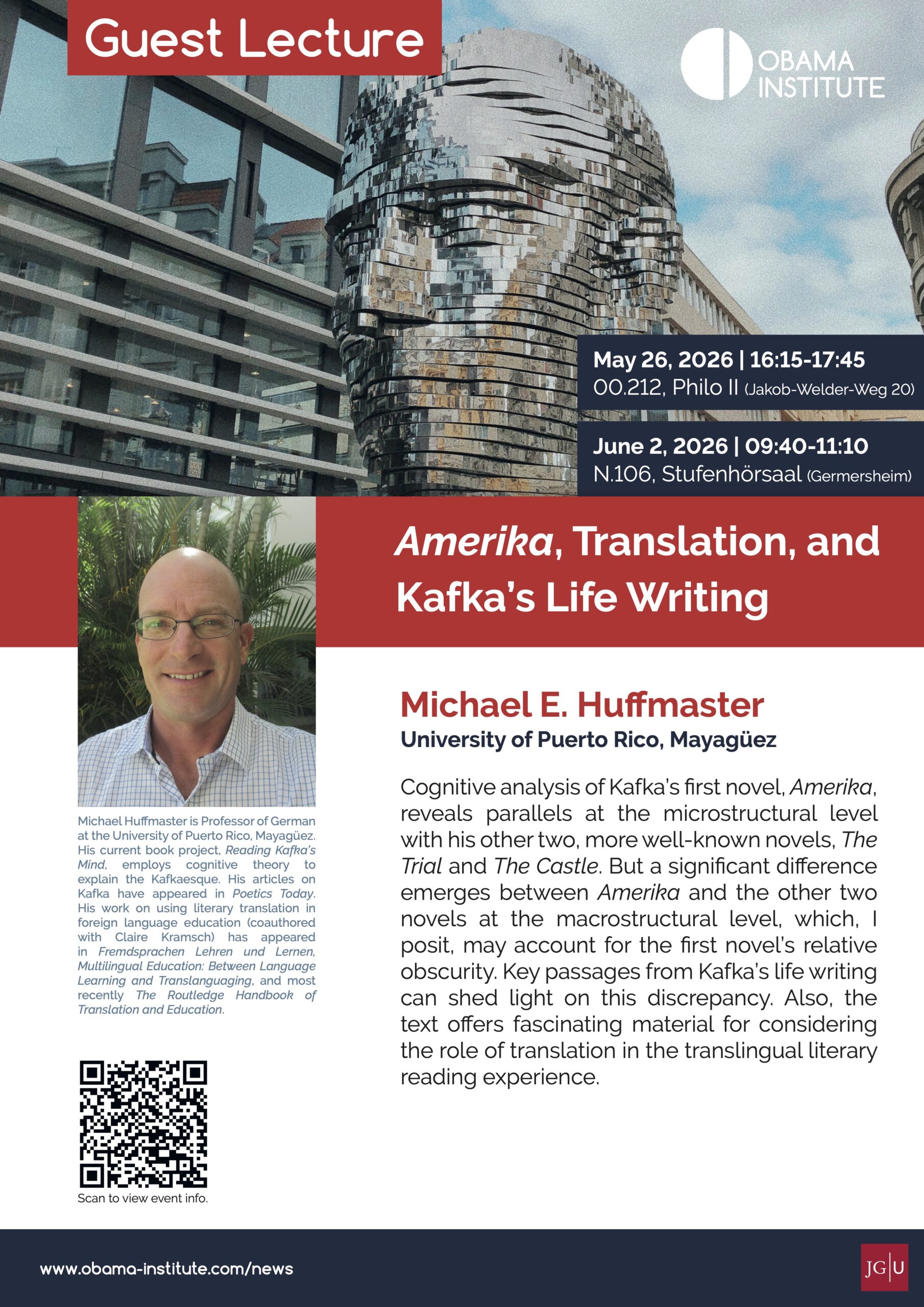
May 26 & June 2 – Guest Lecture: AMERIKA, Translation, and Kafka’s Life Writing 🗓

May 26 & June 2 – Guest Lecture: AMERIKA, Translation, and Kafka’s Life Writing 🗓

Guest Lecture by Michael E. Huffmaster (University of Puerto Rico, Mayagüez)

Amerika, Translation, and Kafka’s Life Writing

May 26, 2026, 4.15-5.45 pm, 00.212, Philo II (Jakob-Welder-Weg 20)

June 2, 2026, 9.40-11.10 am, N.106, Stufenhörsaal (Campus Germersheim)


Cognitive analysis of Kafka’s first novel, Amerika, reveals parallels at the microstructural level with his other two, more well-known novels, The Trial and The Castle. But a significant difference emerges between Amerika and the other two novels at the macrostructural level, which, I posit, may account for the first novel’s relative obscurity. Key passages from Kafka’s life writing can shed light on this discrepancy. Also, the text offers fascinating material for considering the role of translation in the translingual literary reading experience.

Michael Huffmaster is Professor of German at the University of Puerto Rico, Mayagüez. His current book project, Reading Kafka’s Mind, employs cognitive theory to explain the Kafkaesque. His articles on Kafka have appeared in Poetics Today. His work on using literary translation in foreign language education (coauthored with Claire Kramsch) has appeared in Fremdsprachen Lehren und Lernen, Multilingual Education: Between Language Learning and Translanguaging, and most recently The Routledge Handbook of Translation and Education.

You can download the poster for the event here.

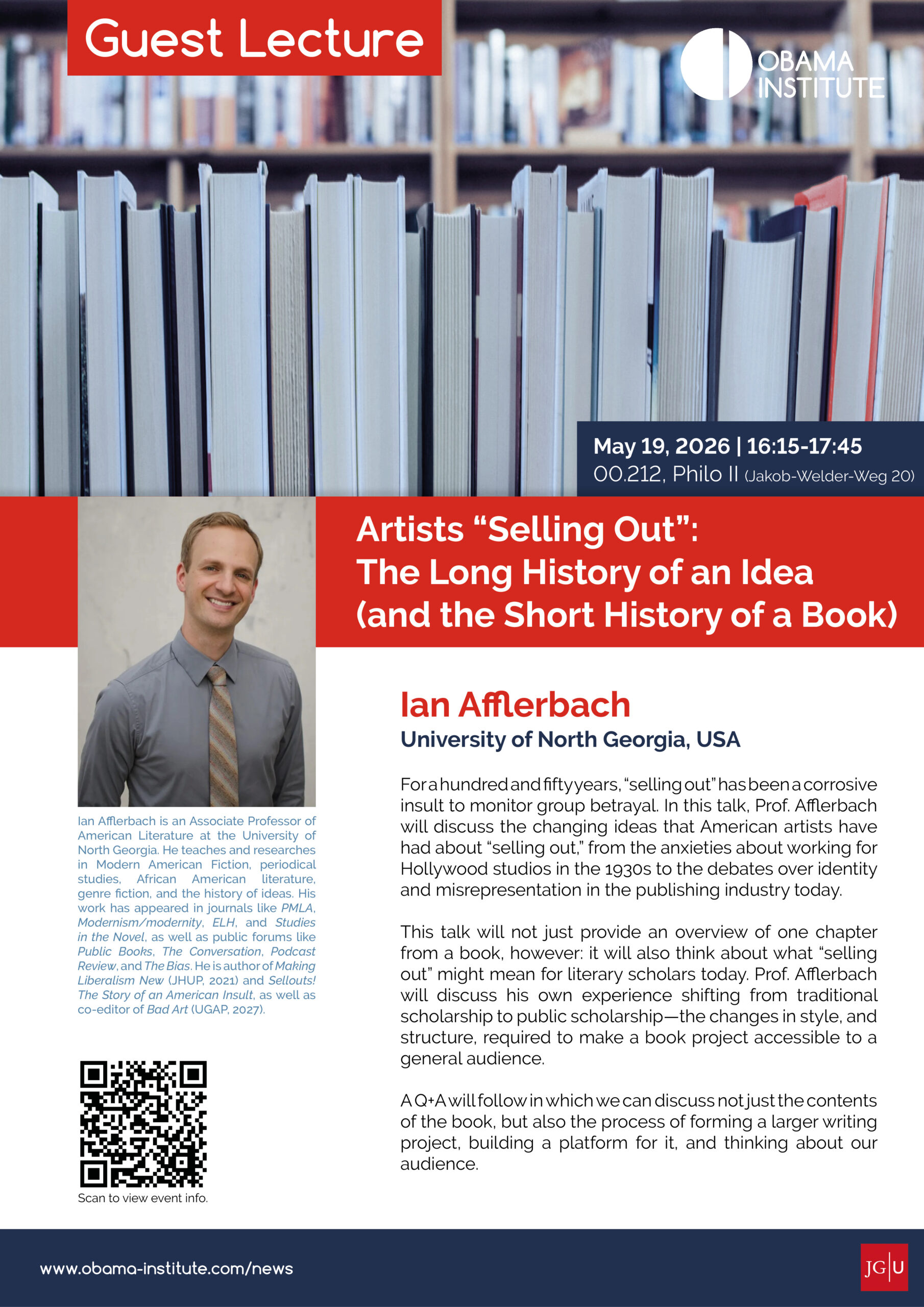
May 19 – Guest Lecture: Artists “Selling Out” The Long History of an Idea (and the Short History of a Book) 🗓

May 19 – Guest Lecture: Artists “Selling Out” The Long History of an Idea (and the Short History of a Book) 🗓

Guest Lecture by Ian Afflerbach (University of North Georgia, USA)

Artists “Selling Out” The Long History of an Idea (and the Short History of a Book)

May 19, 2026, 4.15-5.45 pm, 00.212, Philo II (Jakob-Welder-Weg 20)

For a hundred and fifty years, “selling out” has been a corrosive insult to monitor group betrayal. In this talk, Prof. Afflerbach will discuss the changing ideas that American artists have had about “selling out,” from the anxieties about working for Hollywood studios in the 1930s to the debates over identity and misrepresentation in the publishing industry today.

This talk will not just provide an overview of one chapter from a book, however: it will also think about what “selling out” might mean for literary scholars today. Prof. Afflerbach will discuss his own experience shifting from traditional scholarship to public scholarship—the changes in style, and structure, required to make a book project accessible to a general audience.

A Q+A will follow in which we can discuss not just the contents of the book, but also the process of forming a larger writing project, building a platform for it, and thinking about our audience.


Ian Afflerbach
is an Associate Professor of American Literature at the University of North Georgia. He teaches and researches in Modern American Fiction, periodical studies, African American literature, genre fiction, and the history of ideas. His work has appeared in journals like PMLA, Modernism/modernity, ELH, and Studies in the Novel, as well as public forums like Public Books, The Conversation, Podcast Review, and The Bias. He is author of Making Liberalism New (JHUP, 2021) and Sellouts! The Story of an American Insult, as well as co-editor of Bad Art (UGAP, 2027).

You can download the poster for the event here.
May 7 – Guest Lecture: The Lessons of Banned Books in 21st-Century America 🗓

May 7 – Guest Lecture: The Lessons of Banned Books in 21st-Century America 🗓

Guest Lecture by Corinna Norrick-Rühl & Silvia Schultermandl (University of Münster)

The Lessons of Banned Books in 21st-Century America

May 7, 2026, 6-8pm, P 6 (Philosophicum)

The First Amendment guarantees freedom of speech. However, book banning activities have skyrocketed since 2010, as documented by PEN America and the American Library Association – by 2025, book bans had been “normalized” in contemporary US education contexts. While the Biden administration moved to counteract these often local, regional, and state book banning measures, the second Trump administration declared book bans a “hoax” in January 2025. Escalating this further, Republicans initiated House Resolution 7661 (H.R. 7661), also known as the “Stop the Sexualization of Children Act” in February of 2026, attempting to instate national book bans, with the outcome as yet uncertain (as of March 2026). Against this rapidly evolving backdrop, our interdisciplinary talk, coming from literary studies and book studies, considers the recent novel Lula Dean’s Little Library of Banned Books (HarperCollins/William Morrow 2024) by Kristen Miller. We show how the mainstream fiction novel is both a testament to and form of activist engagement with this historic moment; not only, but also in relation to the upcoming semiquincentennial celebrations in the USA. In our talk, we discuss Miller’s novel as both text and book, including its critical responses on the material, representational, and affective levels. We thus heed the call issued by the Modern Language Association in January of 2026 on “Why We Need the Lessons of Banned Books Now More Than Ever.”

Corinna Norrick-Rühl is Professor of Book Studies at the University of Münster. She has written widely on twentieth- and twenty-first century publishing and reading cultures, with a special interest in popular series and book clubs, mass-market genres, and celebrity book culture. Recent publications include “Genre, Diversity, and Metanarrative in Reese’s Book Club,” published in Contemporary Literature (co-authored with Alexander Starre) and “Moving Memoir Across Markets and Media: A Study of Popular Memoir and Its Genre Effects,” published in Book History (co-authored with Danielle Fuller).

Silvia Schultermandl is Professor and Chair of American Studies at the University of Münster. She is the author of Transnational Matrilineage: Mother-Daughter Conflicts in Asian American Literature (2009) and Ambivalent Transnational Belonging in American Literature (2021) and co-editor of eleven collections of essays and special journal issues which explore various themes in transnational studies, American literature and culture, as well as critical kinship studies. Her articles have appeared in the following journals, among others: Meridians, Atlantic Studies, Interactions, Journal of Transnational American Studies, and Journal of American Culture. Her areas of interest include affect theory, literary theory, critical race theory, queer theory, aesthetics, and transnational feminism. She is currently developing the Palgrave Series in Kinship, Representation, and Difference and is completing a book project on kinship and archives.

You can download the poster for the event here.
Jan 22 – Guest Lecture: Vanishing Oil in John Joseph Mathews’s SUNDOWN (1934) 🗓

Jan 22 – Guest Lecture: Vanishing Oil in John Joseph Mathews’s SUNDOWN (1934) 🗓

Guest Lecture by Jannis Buschky, M.A. (University of Konstanz)

Vanishing Oil in John Joseph Mathews’s Sundown (1934)

January 22, 2026, 6-8pm, P 6 (Philosophicum)

When Osage writer John Joseph Mathews wrote his novel Sundown (1934) about the Osage oil boom in the early twentieth century, he faced a long-standing stereotype about indigenous peoples in the US. The myth of the “Vanishing Indian” confined indigenous peoples in a static past and thus made notions of modernity and indigeneity incongruent in literary and public discourse. In this presentation, I will consider the concept of vanishing in Mathews’s Sundown from the perspective of the energy humanities, a relatively new field which explores the relationship between energy and literature. The foundational premise of the energy humanities, especially as they relate to oil, posits that oil is structurally omnipresent yet largely invisible. Thinking capaciously about the relationship between the invisibility of oil as a normative experience of energy and vanishing as a racialized form of settler history, I read Sundown’s representations of oil as its most potent site where the novel negotiates indigenous absence and presence. My proposition is that Mathews places oil at the center of his interrogation of the vanishing myth. Specifically, I argue that Mathews’s attempt to formulate an indigenous modernity generates an inversed vanishing narrative: rather than crafting a portrayal of oil extraction at the cost of indigenous erasure, Sundown presents oil itself as vanishing in various forms to consolidate an indigenous modernity.

Jannis Buschky’s research focuses on oil in American fiction from the beginning of the twentieth century. He examines the ways in which early imaginaries of oil render extraction zones at the periphery of an emerging fossil fuel-based economy. In his dissertation, The Regional Imaginations of the Early American Oil Extraction Novel, 1900-1945, he inspects how novels register the environmental and social changes around extraction sites in distinct regions. He is part of the ERC-funded research project “Off the Road: The Environmental Aesthetics of Early Automobility.”

You can download the poster for the event here.