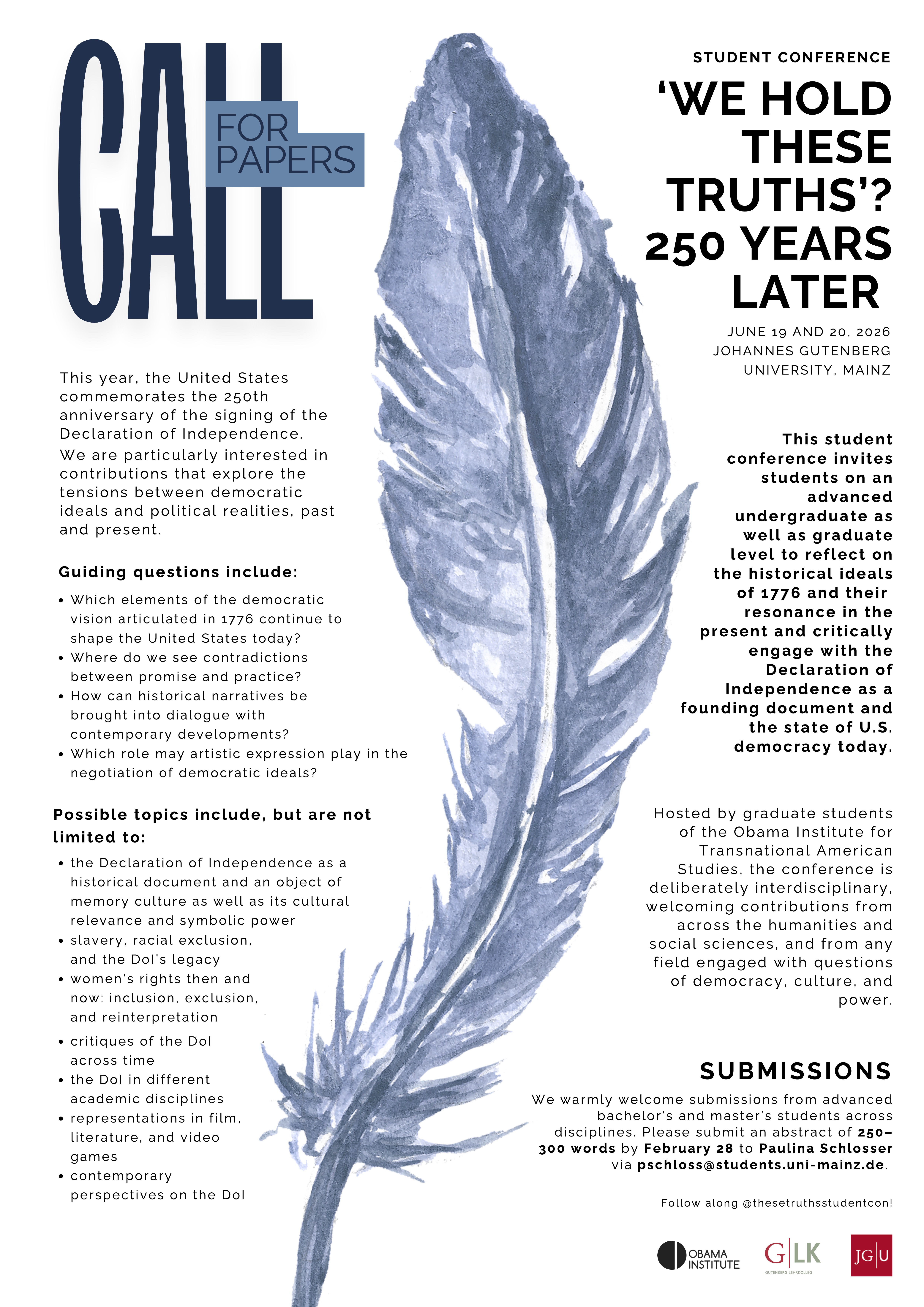
We are pleased to announce the upcomingstudent conference “‘We Hold These Truths’? 250 Years Later,“ hosted by graduate students of the Obama Institute for Transnational American Studies.
Dates: The conference will take place on June 19 and 20, 2026.
Theme: The conference seeks to discuss possible tensions between democratic ideals and political realities, past and present, in light of the 250th anniversary of the Declaration of Independence.
Scope: We welcome contributions from across the humanities and social sciences, and from any field engaged with questions of democracy, culture, and power.
Submission Deadline: Please submit abstracts (300 words) to conference organizer Paulina Schlosser (pschloss@students.uni-mainz.de) by February 28, 2026.
Please find the complete Call for Papers below or download it here for further details about the event.
The conference’s focus is on contemporary tales of metamorphosis. We are especially interested in human to non-human transformations from (queer)feminist, ecocritical, posthuman, and new materialist perspectives to explore the functions that metamorphoses fulfill in literary texts as well as the literary techniques applied in telling stories of transformation.
This conference seeks to open up discussions about literary metamorphoses and to highlight academic work that is dedicated to contemporary literary studies, comparative literature, rewritings of classical myths, and topics of human/non-human transformation. We aim to provide a platform for early career researchers in particular.
In addition to our panels, we are also delighted to welcome Anelise Chen, author of the upcoming hybrid memoir Clam Down (June 2025, Penguin House) and assistant professor of fiction and director of undergraduate studies in creative writing at the Columbia University School of the Arts, for both a reading from her forthcoming novel and as host of our PhD networking event in form of a creative writing workshop on May 22nd.
For further details, please take a closer look at the Call for Papers.
Proposals of no more than 300 words should be submitted along with a short biography to the conference organizers Berenike Jakob, Carolin Jesussek, and Franziska Rauh (metamorphoses@uni-mainz.de) by January 31st. If you are a PhD student interested in joining us for the writing workshop with Anelise Chen (May 22nd), please indicate so when submitting your abstract.
Being (In)Visible: Representations of Disability and Ableism in Popular Culture
Student Conference (Jan 16-17, 2025)
This conference will be organized by Ayishat Aluko, Jill Reuter, and Samira Schwarz, who are all M.A. students of American Studies at JGU’s Obama Institute. The conference is funded by the Gutenberg Lehrkolleg and the Obama Institute for Transnational American Studies. The organizers invite contributions from Master’s students, early stage PhD students and advanced Bachelor’s students of all fields related to disability studies.
For further details, please take a closer look at the Call for Papers.
Abstracts of no more than 300 words should be submitted along with a 100-word biography to disabilities.studentconference@gmail.com by 15 September 2024. Selected participants can expect to be notified by the end of September 2024.
The Transpacific Studies Network (TPSN) was established in the fall of 2022 with the goal of providing new impulses in the research of Pacific cultures, ecologies, histories, literatures, politics, and societies in an interdisciplinary, multi-lingual, and, importantly, transregional manner. Following the successful conference Transcending Boundaries, held in February 2024 at the University of Mainz, Germany, the TPSN is planning to publish a collected volume on the broadly conceived theme of “Transpacific Connections.” To this purpose, we invite scholars, practitioners, and artists to share their research, art and insights concerning the transpacific to submit proposals for articles or artwork exploring connections across national and regional borders in, along, and related to what has been termed the Pacific Rim. We especially encourage suggestions and applications that entail original and alternative indigenous knowledge and scholarship approaches.
For further details, please take a closer look at the Call for Papers.
Proposals of no more than 300 words should be submitted along with a 100-word biography to transpacificstudiesnetwork@gmail.com by October 1, 2024.
Transcending Boundaries–Interdisciplinary Insights in Transpacific Studies
***EXTENDED DEADLINE: 20 September 2023***
Transpacific Studies Network Hybrid Conference February 9-10, 2024 Obama Institute for Transnational American Studies, Johannes Gutenberg University Mainz
We seek contributions that explore connections across national and regional borders in and along the Pacific. The presentations (no format restrictions) should not exceed 20 minutes. The event will serve as a space to discuss early stage-research and on-going projects in this field. We welcome papers deploying new and innovative practices in Transpacific Studies and encourage in particular emerging scholars (current PhD candidates and recent graduates) to apply. This call, however, is not limited solely to scholars, we also welcome artists and practitioners who engage with the region in their work.
Possible topics may include:
Film and television that culturally crosses the pacific ocean
Literary works (novels, memoirs, poems, etc.) from and about (Trans)pacific regions
Representations and/or performances of gender in (Trans)pacific regions
(Trans)pacific mobilities and migration, including policy
The Pacific and the blue humanities
Climate change and the environment in (Trans)pacific regions
(Trans-)Pacific issues of collective memory
Understandings of geography/space/territory in relation to (Trans)pacific regions
Negotiating cultural hybridity
Revitalizations of (Trans)pacific traditional ecological epistemologies
Reflections on practices and imaginations of borders/bordering in the Pacific
Abstracts of no more than 300 words should be submitted along with a 100-word biography to transpacificstudiesnetwork@gmail.com by 20 September 2023. Selected participants can expect to be notified by early October 2023.
Call for Papers (abstract deadline 30 Sept. 2021):
Special Forum on Diagnosing Migrant Experience: Medical Humanities and Transnational American Studies
This special forum of the Journal of Transnational American Studies explores how Transnational American Studies and Medical Humanities can be mutually complementary. At their core, both disciplines work on, with, and beyond phenomena of multiple crossings of geographic, cultural, linguistic, epistemological, material, and physical borders.In doing so Transnational American Studies and Medical Humanities perpetually transgress their disciplinary borders. Hence, this special issue focuses on the crossroads of the two disciplines where each of these can fruitfully enhance the other.
In Medical Humanities approaches such as Narrative Medicine, the focus has been on the individual illness experience; migration-related questions such as racialization or trauma have only recently been coming to the fore. Here, migration is inextricably linked to questions of social justice. Seen from this perspective, Medical Humanities have been enriched through the perspective on migration studies. Similarly, issues of migration have also loomed large in Transnational American Studies. Work in this field has stressed the ways in which, through migrants’ perspectives, the US nation-state was seen from the outside and the inside simultaneously. At the same time, migrant experience has often been characterized by processes of racialized exclusion, economic poverty, and personal and collective trauma. These latter concerns have also centrally been investigated by the field of Medical Humanities. The current Covid-19 pandemic has once again shown that, in epidemiological terms, national boundaries cannot be policed. More than ever, there is a need for concepts and methodologies which enable us to think the medical and the transnational at one and the same time and ask for the role of literature and art within this process.
This special forum proposes that Transnational American Studies and Medical Humanities may fruitfully converge in reconfiguring different concepts of life. Through the lens of Transnational American Studies, this forum looks at how lives have been excluded by immigration bans and national border policing. In this context, Transnational American Studies emerges as a framework to make these lives visible by mapping them not only in a literal, but also in a figurative sense. Moreover, these border crossings often come at a price for those who cross the line in both a metaphorical and an actual sense: Migration and cultural invisibility can be accompanied by trauma and displacement. In this context, exhibitions and artworks on undocumented migration have emphasized the ways in which art and performance can go beyond narrative depictions of the traumas that can accompany forced migration and undocumented lives. At the intersection between migration and trauma, the borders that are being crossed are both land borders and waterways.
The experience of migration can also, quite literally, be combined with a lack of access to health care especially for undocumented migrants and unaccompanied minors. Seen from this perspective, migrant lives are in a form of double jeopardy as dramatically demonstrated, e.g., by the current distribution crisis of Covid-19 vaccines. In this context, literary narratives––novels, poems, short stories, biographies, and autobiographies––emerge as an alternative form of representation: First, they may resist both national policies of exclusion by literally writing migrant lives into the script of the nation. Second, they may defy a mere focus on medical diagnosis, especially where this diagnosis is divorced from cultural context. Defying these categories, these narratives may revolve around “unruly” subjects who refuse to be contained.
Linking illness, mental health, and trauma, such representations can also serve as a critique of health care systems. Nation-states can draw a line between those who are eligible for health care and those who are seen as “undeserving” of such care. Recent investigation as well as historical research has revealed that medical care and adequate nutrition can be withheld by state institutions. As forms of medical negligence or health injustice, such practices have been documented regarding residential schools for Native American children as well as vis-à-vis inmates of state prisons. In all these different contexts, Medical Humanities are closely connected to considerations of social justice and health equity. Instances of an absence of medical care, in turn, can be tied to the crossing of national or internal borders with which Transnational American Studies has also been concerned.
For this special forum, we seek contributions that explore the intricate connections between medical and migrant experiences and their cultural impact in past and present, such as
– Migration and mental health/trauma
– Migration and somatic manifestations
– Migration and challenges for health care systems
– Migration of medical knowledge
– Migration of medical professionals
– Migration and narrative medicine
– Migration and epi-/pandemics
– Migration and disability
– Migration and age
– Migration and global health/one health
– Migration and medical ethics
Please submit a 250-word abstract by September 30, 2021. The editors will review abstracts and invite full-length essays of 5,000–8,000 words. Please email abstracts and questions to Prof. Dr. Mita Banerjee (mita.banerjee@uni-mainz.de) and Dr. Davina Höll (davina.hoell@uni-tuebingen.de).