
Lectures, News
Alfred Bendixen (Princeton University)
Tuesday, January 29, 2018; 6 p.m.–8 p.m. (c.t.) Philosophicum I, P15
 Professor Alfred Bendixen of Princeton University explores the intersection of language and domestic space in establishing the feminist foundations of Mary Wilkins Freeman‘s strongest short fiction. Through the careful manipulation of dialogue and silence, Freeman investigates the struggle of women to achieve a meaningful voice. in her meticulous rendering of physical space, particularly the domestic spaces that women claim as their own, she defines the ways in which women can maintain or lose personal autonomy. The presentation focuses on three of Freeman‘s best stories: „The Revolt of ‚Mother,‘“ „A New England Nun,“ and „A Village Singer.“
Alfred Bendixen received his Ph.D in 1979 from the University of North Carolina and taught at Barnard College, California State University, Los Angeles, and Texas A&M University before joining the Princeton faculty in 2014. Much of his scholarship has been devoted to the recovery of 19th-century texts, particularly by women writers, and to the exploration of neglected genres, including the ghost story, detective fiction, science fiction, and travel writing. His teaching interests include the entire range of American literature as well as courses in science fiction, graphic narrative, and gender studies.
You can download a poster for the lecture here.
Lectures, Lunch Lectures, News
Danielle Spencer (Columbia University)
January 22, 2019, 12-2 p.m. 02-709 Georg-Forster Gebäude
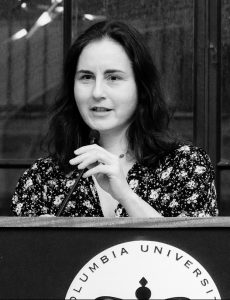 In this project I “diagnose” a phenomenon I term discovering difference: the experience of newly learning in adulthood that one has a longstanding cognitive or perceptual difference from the norm, particularly one that may be considered pathological. It can occur when the condition has remained undetected, such as becoming aware that one is colorblind, and/or when the diagnostic categories themselves have shifted, as with the emergence of autism spectrum disorders or ADHD. This phenomenon has received relatively scant attention, yet learning of an unknown condition is frequently a significant and bewildering revelation, subverting narrative expectations and customary categories. In addressing the topic I articulate and deploy an evolution of narrative medicine as a robust research methodology comprising interdisciplinarity, narrative attentiveness, and creating a writerly text. Beginning with my own experience of discovering difference, I explore the issues it raises—from communicability to narrative intelligibility to different ways of seeing. Next, I map the phenomenon’s distinctive narrative arc through the stages of recognition, subversion, and renegotiation, and finally discuss this trajectory in light of others’ experiences. I propose that interdisciplinary understanding as well as the figure of blindsight—drawn from my own experience—offers a productive model for negotiating such revelations and for holding different forms of knowledge in generative tension. Better understanding discovering difference will aid those directly affected; moreover, it serves as a bellwether for how we will all navigate advancing biomedical and genomic knowledge, and how we may integrate medico-scientific revelations with what we understand to be our identities.
Danielle Spencer is a faculty member of the Program in Narrative Medicine at Columbia University. She is a co-author of The Principles and Practice of Narrative Medicine (Oxford University Press, 2017) and her work appears in a range of outlets, from Ploughshares to The Lancet. Her research interests include the intersection between narrative, identity, and diagnosis; bioethics and speculative fiction, and healthcare professions pedagogy. Spencer worked as artist/musician David Byrne’s Art Director for many years, collaborating on and exhibiting a range of projects, as well as with photographer Nan Goldin. She holds a B.A. from Yale University and an M.S. in Narrative Medicine from Columbia University, and a Ph.D. des. in American Studies at Johannes Gutenberg University Mainz.
You can download the poster for this talk here.
Lectures, Lunch Lectures, News
Sophia L. Bamert (University of California, Davis)
January 24, 2019, 12-1 p.m., 02.102 (Philo II)
In 1915, sociologist Robert E. Park described the modern city as “a mosaic of little worlds which touch but do not interpenetrate,” a spatial—and racial—imaginary that had already been expressed in Jacob Riis’s portrayal of the Lower East Side as an “extraordinary crazy-quilt” of ethnic immigrant groups in his 1890 exposé How the Other Half Lives and that was reinforced in the 1930s by the Home Owners’ Loan Corporation “redlining” maps. My research considers how the entanglements of geographic imaginaries and material conditions serve to racialize urban space, emphasizing the role of narrative in both upholding and homogenizing geographic representations but also in critiquing those representations by revealing the very narrativity of their construction. I focus on Chicago in the early twentieth century, where the “Chicago School” sociologists taught literature as a window into the urban psyche and interacted with local authors such as Richard Wright. This was, significantly, a moment at which Chicago was America’s most iconic and rapidly growing city, a period during which the intersecting histories of American urbanism, immigration, and the Great Migration also laid the groundwork for the city’s notorious—and still existent—segregation. Bringing together narratology and cultural geography, my talk will theorize the relationship between narrative mapping and racialized space by bringing together turn-of-the century realist novels (Henry Blake Fuller’s The Cliff-Dwellers and Theodore Dreiser’s Sister Carrie) with Chicago Black Renaissance short fiction (Marita Bonner’s Frye Street stories).
Sophia Bamert is a PhD candidate in English with a designated emphasis in Writing, Rhetoric, and Composition Studies at the University of California, Davis. She holds a BA in English and Environmental Studies from Oberlin College and an MA in English from UC Davis. Sophia is currently a visiting lecturer at the Obama Institute for Transnational American Studies at JGU Mainz.
You can download the poster for this talk here.
Lectures, News
Jutta Zimmermann (Christian-Albrechts-Universitat zu Kiel)
Dec 18, 2018, 9.40-11.10 a.m., Room 328 (Campus Germersheim, FB 06)
In recent years, slavery has been the topic of a whole number of popular literary texts and films. Compared to earlier representations, these latest works are produced within a particular historical and cultural context: the presidency of Barack Obama and the emergence of the Black Lives Matter movement. Whitehead’s novel – but also films like Steve McQueen’s Twelve Years a Slave or Nate Parker’s The Birth of a Nation – respond to and negotiate between competing claims about race relations in the U.S.: Is the first black president an indication that racism has been overcome? Or, has slavery never come to an end and persists in the present? In order to answer these questions, the presentation will make an attempt to trace the role that slavery has played in African American culture since the 1960s.
You can find the poster for the event here.
Lectures, Lunch Lectures, News
Vanessa Evans (York University, Canada)
December 13, 2018, 12-1 p.m., 02.102 (Philo II)
Too often, the pull of the policy audience has resulted in decolonization being enlisted as a hollow metaphor that seeks to reconcile settler complicity and secure settler futurity. This seduction has immense consequences for the substance, style, and politics of research in Indigenous studies. As such, the field of Indigenous literary study cannot blindly adopt the agendas of those making or administering policy. I advocate that a primary impediment to an increased consciousness about Indigeneity lies in how we study the contemporary literature of Indigenous peoples. This requires a reconceptualization of Indigeneity away from its boundedness to specific lands and pasts that valorize ties to first contact, instead embracing the reality that Indigenous peoples are a contemporary presence throughout the world. In response to this reimagining, my research investigates: (i) how the study of Indigenous world literatures might destabilize characterizations of absence that isolate Indigenous peoples to particular places and pasts, and (ii) how these literatures can entrench Indigenous presence as planetary phenomenon. I make this intervention by modeling a cosmic methodology that recognizes Indigeneity and Indigenous peoples as omnipresent and thriving; it is, at its heart, a project that contributes to the ongoing work of decolonizing literary study itself through the minds of those who study and teach literature.
Vanessa Evans is a doctoral candidate in the Department of English at York University. She holds a B.A. in English from the University of Calgary and an M.Litt. in Modernities from the University of Glasgow. Vanessa is currently a visiting lecturer at the Obama Institute for Transnational American Studies at JGU Mainz.
You can download the poster for this talk here.
Lectures, News
Russ Castronovo (University of Wisconsin-Madison, USA)
Nov 28, 2018, 4-6 p.m., P 103 (Philosophicum)
Russ Castronovo is Tom Paine Professor of English and Dorothy Draheim Professor of American Studies at the University of Wisconsin-Madison, USA, where he is also Affiliate Faculty Member of the Center for the History of Print and Digital Culture.
You can find the poster for the event here.