In a 2014 interview for the National Endowment for the Arts Works Blog, Javier Zamora states, “I think in the United States we forget that writing and carrying that banner of ‘being a poet’ is tied into a long history of people that have literally risked [their lives] and died to write those words.”
Join us for an evening of poetry withJavier Zamora, acclaimed author of the full-length poetry collection Unaccompanied (Copper Canyon Press, 2017), featuring poetry written about his experience travelling without documentation from El Salvador to the United States to be reunited with his parents at the tender age of 9. Zamora will read from this collection as well as some newer material and discuss the writing process. At the end of the reading, there will be time for a short Q&A with the poet.
Currently, Javier Zamora is engaged at JGU leading “ReWriting Migrant Integration: Creative Writing as a Chance for Intercultural Exchange,” a seminar and creative writing workshop, together with Dr. Eva Klein and Ana Elisa Gomez Laris as part of this semester’s Studienprogramm Q+ course offering. Alongside Q+ students, two students from the Obama Institute are also taking part in this course. More information on this course may be found here.
Zamora holds a BA from UC Berkeley and an MFA from NYU. Over the years, he has been the recipient of the 2015 National Endowment for the Arts Fellowship, the 2016 Ruth Lilly Fellowship, a 2016-2018 Wallace Stegner Fellowship, the 2017 Lannan Literary Fellowship, and the 2017 Narrative Prize. His memoir, Solito, is slated to be published by Random House in 2022.
For questions about Javier Zamora’s reading or on the The Poetry Reading Series in general, please contact Prof. Dr. Florian Freitag or Ana Elisa Gomez Laris (both from the University of Duisburg-Essen).
“Claiming ‘The Great Black North’ in Contemporary Short Stories from Canada“
Dr. Nele Sawallisch (Catholic University Eichstätt-Ingolstadt, Germany)
Dec 15, 09:40-11:00, BigBlueButton
Free access: https://bbb.rlp.net/b/ern-ciz-knc-2v5 (BigBlueButton does not require a standalone app and works best on Mozilla Firefox or Google Chrome. Safari and other browsers can cause technical issues.)
Canada’s popular moniker of “the Great White North” has long exceeded its reference to the land of ice and snow, assuming another metaphorical meaning in the context of the country’s demographic. Despite the adoption of an official policy of multiculturalism in the latter half of the 20th century, to immigrant populations as well as BIPoC in Canada, the country has often proven less than welcoming both in diachronic and synchronic perspectives. This talk therefore considers short fiction by Black Canadian and second-generation Black authors that negotiates the intersections of Blackness, Canada, and belonging. On the one hand, their short stories posit experiences of discrimination and racism as facts in the daily lives of BIPoC in Canada despite its professions of a tolerant multicultural society. On the other hand, the authors also appropriate and claim Canada’s geography to map histories, presents, and futures of a “Great Black North” that “remix[es]” (Mason-John and Cameron 2014) Canada’s story as we know it.
Dr. Nele Sawallisch works as a senior lecturer in American Studies at Catholic University Eichstätt- Ingolstadt, Germany. Her first monograph Fugitive Borders: Black Canadian Cross-Border Literature at Mid-Nineteenth Century (transcript, 2019) discusses community-building processes and genealogies in autobiographical writing by formerly enslaved men from the 1850s in the North American borderland between the United States and Canada.
Come join us online for the annual Thanksgiving Obama Lecture, where we will hear from the Obama Institute’s Executive Board members about the OI’s activities and current research and will award the Obama Dissertation Prizes as well as the Galinsky Prize for outstanding PhD and undergrad work. Each recipient will present their project and we will open a conversation about their work as part of and in relation to the research conducted at the OI.
Please download the flyer here or see below. It includes more information and access details.
Watch Songs That Never End (2019) on-demand Nov. 14-21 (register on eventbrite)
Talk with filmmaker Yehuda Sharim Nov. 19, 6 pm CET (on BigBlueButton)
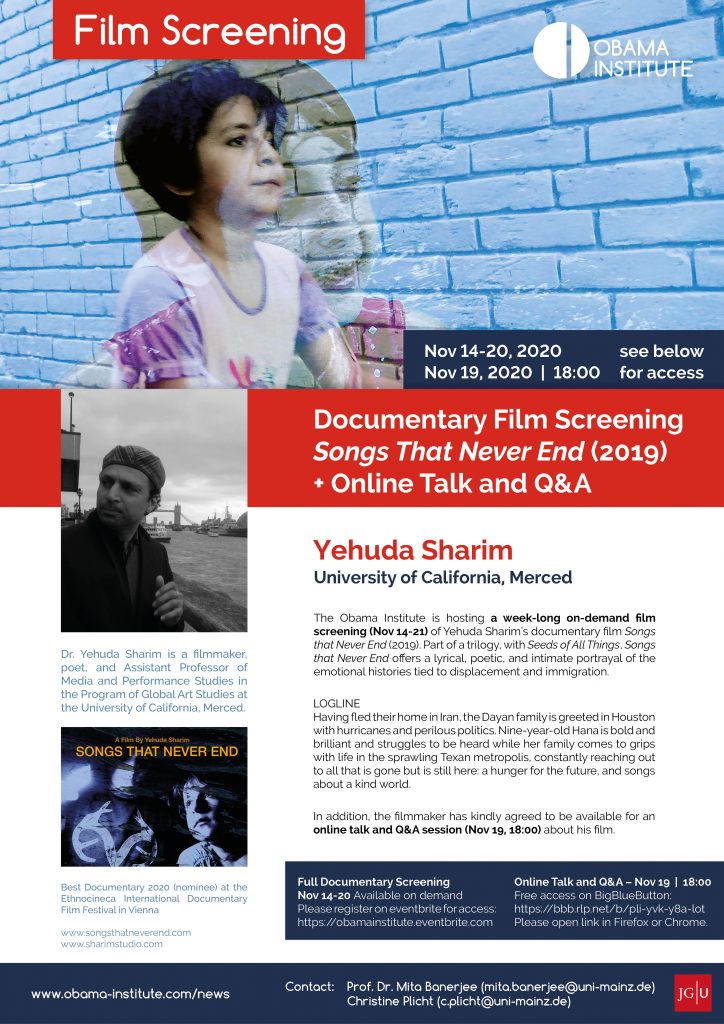
The Obama Institute is hosting a week-long on-demand film screening (Nov 14-21, https://obamainstitute.eventbrite.com) of Yehuda Sharim’s documentary film Songs that Never End (2019). Part of a trilogy, with Seeds of All Things, Songs that Never End offers a lyrical, poetic, and intimate portrayal of the emotional histories tied to displacement and immigration.
LOGLINE Having fled their home in Iran, the Dayan family is greeted in Houston with hurricanes and perilous politics. Nine-year-old Hana is bold and brilliant and struggles to be heard while her family comes to grips with life in the sprawling Texan metropolis, constantly reaching out to all that is gone but is still here: a hunger for the future, and songs about a kind world.
In addition, the filmmaker has kindly agreed to be available for an online talk and Q&A session (Nov 19, 18:00, https://bbb.rlp.net/b/pli-yvk-y8a-lot) about his film.
Come join us and share your questions and thoughts on the film or simply listen to the discussion!
For more details and all links to the event, please see or download the poster here or click on the image below.
On Nov 11 the Obama Institute will hold info sessions on its Direct Exchange programs. Please join us on BigBlueButton for more information about the exciting exchange opportunities!
We would very much like to invite you to the virtual guest lecture by Prof. Yehuda Sharim (UC Merced). Prof. Sharim is an accomplished scholar, a professor in film and performance studies, as well as an award-winning film director. His films provide alternative visions on migration, transnational mobility, class and cultural belonging. He will especially speak about and screen excerpts from his recent films, Songs that Never End (2019) and Seeds of All Things (2018).
For more details and the link to the event, please see or download the poster here.
We are very much looking forward to seeing you (electronically) at the lecture!
(BigBlueButton does not require a standalone app and can be run in any browser without registration.)