after this year’s annual meeting of the historians in the DGfA/GAAS had to move online, we hope that many of us will be able to come together next year for a more in-person event, though we are planning on virtual components for those who may still be kept from traveling.
The Annual Meeting of the Historians in the German Association for American Studies (DGfA) will take place February 11-13, 2022, at Johannes Gutenberg University Mainz, Germany.
We are delighted to present you with a call for papers for this event:
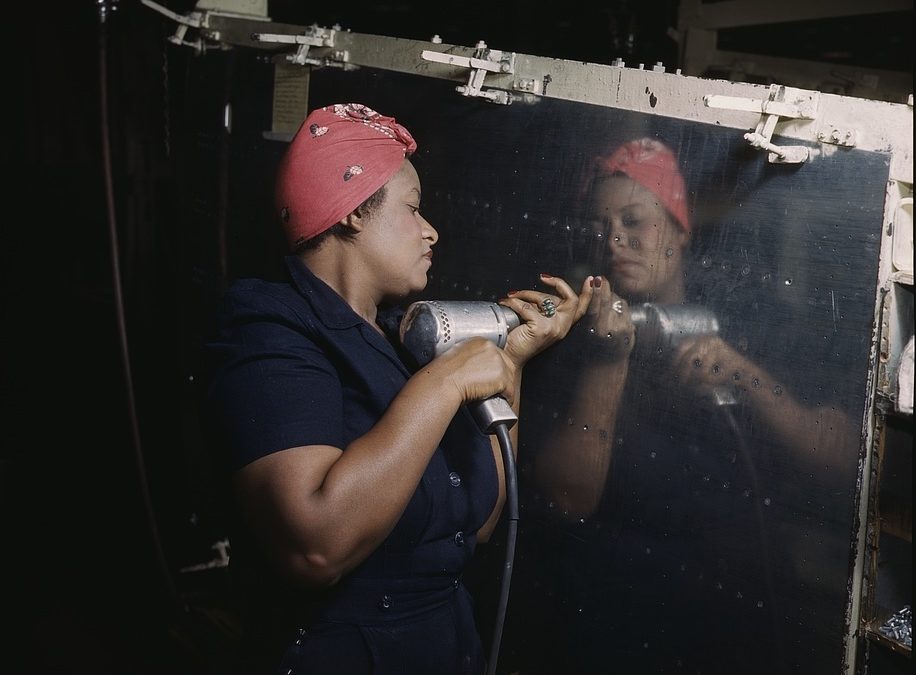
Call for Papers: Labor and Immigration in U.S. History
The transnational turn has introduced significant new perspectives on the history of labor and capitalism in the United States. While the state remains an important object of analysis, decentering the nation in labor history provides additional lenses that focus on circulations, interactions, and connections below or beyond the nation-state. According to Ian Tyrell, they focus attention on exchanges across national boundaries, the impact of asymmetrical power exerted by one nation, and networks of relations not contained by nation-states. In questioning a coherent, all-encompassing national narrative, the voices and visions of people and groups who have been marginalized in the context of a nationalist myopia are reclaimed. The experiences of non-citizens and migrants, labor sojourners and “birds of passage,” inhabitants of border regions, workers of international corporations, and new digital and remote workers help provide a more complete and more complex picture of what both labor and capital have meant in various historical contexts. Negotiations of labor rights, property rights, the rights of capital or corporate personship from the emergent nation-state to globalization accounts for different appraisals of labor heroes or radicals, benevolent tycoons or robber barons. Historians such as Kiran Klaus Patel, for example, root the history of the New Deal in a global context, connecting the history of labor and capital to that of U.S. hegemony in the twentieth century. Others, such as Julie Greene, connect the immigrant experience with American empire. Likewise, Donna Gabaccia focuses on the migration world of Italian workers, and Mae Ngai traces the role of “impossible” illegal immigrant workers in the making of America.
This conference seeks to put into communication various strands of the recent historiography in labor history. To this end, we invite both individual papers and panel proposals on topics including:
Please send short CVs and abstracts for individual papers of no longer than 500 words and in the case of a panel proposal an additional introduction of no longer than 300 words to the organizers until July 23, 2021 to this address: dgfahist2022@uni-mainz.de
the changing world of labor (industrialization, urbanization, post-industrialization, digitalization, etc.)
labor strife
labor and gender
labor, race, ethnicity, and migration
internationalization of labor markets
working class culture and solidarity
changing forms of employment (small-self-employed farmers to employees and factory workers, to the new gig-economy)
labor and space (from home-production and small workshops, to industrial spaces, the open plan office, and call centers, to post-industrial coworking spaces, creative office playrooms, and work from home setups)
labor in different geographical contexts
the contemporary role and perception of capital and capitalists during a given historical era
Due to continuing uncertainties regarding travel and in-person meetings because of the COVID-19 pandemic, this conference will take place in a hybrid format at Johannes Gutenberg University Mainz and online. When applying, please indicate whether you plan on attending in person or joining us virtually. For those attending in person, we will provide information on accommodation, but please make sure to organize your own stay in Mainz.
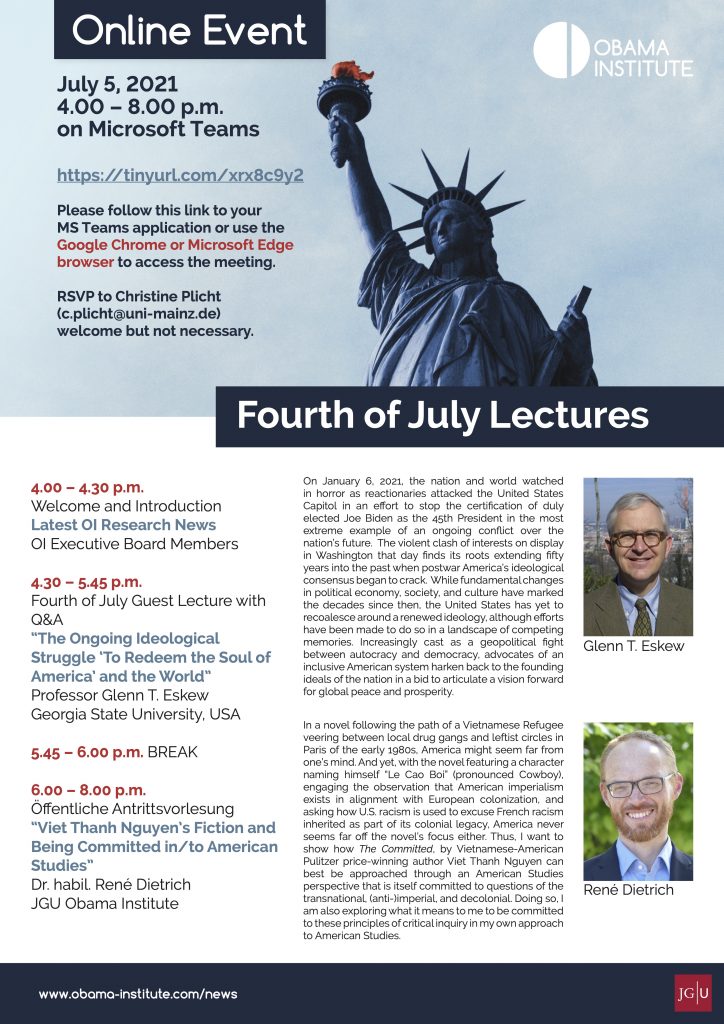
We would like to invite everyone to the Obama Institute’s annual Fourth of July Lecture on July 5 (4 p.m.). Members of the OI Executive Board will start by briefly introducing the latest news in Research at the OI, including the recently established SFB 1482 “Humandifferenzierung”, which was approved for its first four years of funding by the Deutsche Forschungsgemeinschaft (DFG) just a few weeks ago.
Then, we will welcome Professor Glenn T. Eskew from Georgia State University for a talk on “The Ongoing Ideological Struggle ‘To Redeem the Soul of America’ and the World” before Dr. habil. René Dietrich will give his Öffentliche Antrittsvorlesung on “Viet Thanh Nguyen’s Fiction and Being Committed in/to American Studies” in order to formally complete his Habilitation and receive his Venia Legendi.
Please see below or here for more details on the talks and our schedule.
Access
July 5, 4 – 8 p.m. You can join the event on MS Teams at any time for any or all talks by following the link on the poster or here: https://tinyurl.com/xrx8c9y2
An installation of the MS Teams application is recommended but not necessary. MS Teams will also let you access the meeting in a browser through its web client. Google Chrome or Microsoft Edge work best. Apple’s Safari is not fully supported!
RSVP to c.plicht@uni-mainz.de is welcome but not necessary. If you register, you will receive an email through MS Teams with the link and Teams calendar event prior to the event.
Program
4.00 – 4.30 p.m. Welcome and Introduction Latest OI Research News OI Executive Board Members
4.30 – 5.45 p.m. Fourth of July Guest Lecture with Q&A “The Ongoing Ideological Struggle ‘To Redeem the Soul of America’ and the World” Professor Glenn T. Eskew Georgia State University, USA
5.45 – 6.00 p.m. BREAK
6.00 – 8.00 p.m. Öffentliche Antrittsvorlesung “Viet Thanh Nguyen’s Fiction and Being Committed in/to American Studies” Dr. habil. René Dietrich JGU Obama Institute
Talks
“The Ongoing Ideological Struggle ‘To Redeem the Soul of America’ and the World” – Professor Glenn T. Eskew On January 6, 2021, the nation and world watched in horror as reactionaries attacked the United States Capitol in an effort to stop the certification of duly elected Joe Biden as the 45th President in the most extreme example of an ongoing conflict over the nation’s future. The violent clash of interests on display in Washington that day finds its roots extending fifty years into the past when postwar America’s ideological consensus began to crack. While fundamental changes in political economy, society, and culture have marked the decades since then, the United States has yet to recoalesce around a renewed ideology, although efforts have been made to do so in a landscape of competing memories. Increasingly cast as a geopolitical fight between autocracy and democracy, advocates of an inclusive American system harken back to the founding ideals of the nation in a bid to articulate a vision forward for global peace and prosperity.
“Viet Thanh Nguyen’s Fiction and Being Committed in/to American Studies” – Dr. habil. René Dietrich In a novel following the path of a Vietnamese Refugee veering between local drug gangs and leftist circles in Paris of the early 1980s, America might seem far from one’s mind. And yet, with the novel featuring a character naming himself “Le Cao Boi” (pronounced Cowboy), engaging the observation that American imperialism exists in alignment with European colonization, and asking how U.S. racism is used to excuse French racism inherited as part of its colonial legacy, America never seems far off the novel’s focus either. Thus, I want to show how The Committed, by Vietnamese-American Pulitzer price-winning author Viet Thanh Nguyen can best be approached through an American Studies perspective that is itself committed to questions of the transnational, (anti-)imperial, and decolonial. Doing so, I am also exploring what it means to me to be committed to these principles of critical inquiry in my own approach to American Studies.
In a 2014 interview for the National Endowment for the Arts Works Blog, Javier Zamora states, “I think in the United States we forget that writing and carrying that banner of ‘being a poet’ is tied into a long history of people that have literally risked [their lives] and died to write those words.”
Join us for an evening of poetry withJavier Zamora, acclaimed author of the full-length poetry collection Unaccompanied (Copper Canyon Press, 2017), featuring poetry written about his experience travelling without documentation from El Salvador to the United States to be reunited with his parents at the tender age of 9. Zamora will read from this collection as well as some newer material and discuss the writing process. At the end of the reading, there will be time for a short Q&A with the poet.
Currently, Javier Zamora is engaged at JGU leading “ReWriting Migrant Integration: Creative Writing as a Chance for Intercultural Exchange,” a seminar and creative writing workshop, together with Dr. Eva Klein and Ana Elisa Gomez Laris as part of this semester’s Studienprogramm Q+ course offering. Alongside Q+ students, two students from the Obama Institute are also taking part in this course. More information on this course may be found here.
Zamora holds a BA from UC Berkeley and an MFA from NYU. Over the years, he has been the recipient of the 2015 National Endowment for the Arts Fellowship, the 2016 Ruth Lilly Fellowship, a 2016-2018 Wallace Stegner Fellowship, the 2017 Lannan Literary Fellowship, and the 2017 Narrative Prize. His memoir, Solito, is slated to be published by Random House in 2022.
For questions about Javier Zamora’s reading or on the The Poetry Reading Series in general, please contact Prof. Dr. Florian Freitag or Ana Elisa Gomez Laris (both from the University of Duisburg-Essen).
DFG (German Research Foundation) approves €10m in funding for a new Collaborative Research Center on “Human Differentiation” (SFB 1482)
The Obama Institute proudly confirms its participation in the new Collaborative Reseach Center “Human Differentiation” (SFB 1482), which has recently been approved for funding by the German Research Foundation (DFG). The Center will be established in July 2021 with an initial funding period of four years and potential renewals for up to twelve years.
The Center brings together a multitude of different research areas from the Social and Cultural Studies at Johannes Gutenberg University, Mainz (JGU) in order to explore categories of human differentiation. It will also build and establish a theoretical framework for the analysis of processes of categorization.
Dear colleagues, this year the annual conference of the historians within the GAAS/DGfA must move online. We hope you will join us for the meeting on Zoom on February 26, 2021. (Links will be posted here closer to the time of the event.)
Conference Program
14:00 CET Introduction
14:30–16:00 CET Keynote Julie Greene “Workers of the World: U.S. Empire, Class, and Capitalism” followed by responses by Andreas Etges and Mischa Honeck
(15 minute break)
16:15–17:45CET Keynote Eileen Boris “Neither Free Nor Slave: Migrant Domestic Workers, The Employment Agency, and Reproductive Labor Under Capitalism” followed by responses by Britta Waldschmidt-Nelson and Silke Hackenesch
(15 minute break)
18:00–19:30 CET Business Meeting
Login Information (For keynotes only. The business meeting will be held for eligible members, who have received separate communication about it.)
Time: 26. Feb., 2021, 02:30 PM Amsterdam, Berlin, Rom, Stockholm, Wien
The journal Early American Literature (UNC Press) has published a conference review of the Obama Institute’s 2018 conference “Transatlantic Conversations: New and Emerging Approaches to Early American Studies”.