News, Workshops
Career Workshop: American Art
February 8, 2019
Helmholtz Institute Mainz
Staudingerweg 18
55128 Mainz
Conference Room 1395-00-133/135 (Ground Floor), 10 a.m.–11 a.m.
Interested in studying American art, working in museums, applying for research funding, or pursuing an academic career? In this unique workshop, speakers from the symposium International Perspectives on American Art will share their varied career paths in an informal discussion with students.
Speakers:
Dr. Christian Berger, Johannes Gutenberg-Universität Mainz/The Courtauld Institute of Art, London
Prof. Dr. Winfried Fluck, John F. Kennedy Institute for North American Studies, Freie Universität Berlin
Prof. Dr. Ursula Frohne, Institut für Kunstgeschichte, Westfälische Wilhelms-Universität Münster
Eleanor Harvey, Ph.D., Senior Curator, Smithsonian American Art Museum, Washington, D.C.
Anna O. Marley, Ph.D., Curator of Historical American Art, Pennsylvania Academy of Fine Arts, Philadelphia
Susanne Scharf, M.A., Frankfurt am Main
Space is limited. Please register by email to Dr. Allison M. Stagg: allstagg@uni-mainz.de by February 1.
You can download the poster for the workshop here.
Title image: George Caleb Bingham, American, 1811–1879; The Wood-Boat, 1850; oil on canvas mounted on board; 25 1/8 in. × 30 inches; Saint Louis Art Museum, Museum Purchase 14:1951
Events, Lectures, News
Denise Uyehara (Performance Artist)
February 7, 2019
6-8 p.m., P 203 (Philosophicum)
This evening, Denise Uyehara discusses her work as part of the Fifth World Collective, a group of Indigenous and non-indigenous artists from the Southwest, U.S., as they developed Shooting Columbus. She will also describe previous projects in which she explored her Okinawan and Japanese heritage in the context of the U.S. military occupation of the Okinawan islands, solo endeavors, and her work as part of the Sacred Naked Nature Girls.
Denise Uyehara is an award-winning performance artist who investigates memory, body and intersections of identity.
www.deniseuyehara.com
You can download the poster for the event here.
Conferences, News
International Perspectives on American Art
The symposium, International Perspectives on American Art, brings together scholars from the United States and Europe, from university departments of American Studies, Art History, Literature, and from museum curatorial positions, that are presently engaged in exploring American art within a broad context. Seeking to stimulate interdisciplinary exchange, the symposium is an opportunity to explore the reception and perception of American art outside of the United States in museum exhibitions, research, and in the academic classroom.
February 7, 2019
Helmholtz Institute Mainz
Staudingerweg 18
55128 Mainz
Conference Room 1395-00-133/135 (Ground Floor), 10 a.m.–6 p.m.
In November of 2018, an ambitious exhibition on American art opened at the Wallraf-Richartz Museum & Foundation Corboud in Cologne, Once Upon a Time in America: Three Centuries of American Art. On display in the galleries are over 100 loans of paintings, works on paper, and sculpture from American collections, the majority of which have never been on view in a German museum. It introduces to a primarily German audience important and well-known art objects from the 1700s to the mid-twentieth century, focusing on select periods that influenced and shaped art in America.
This exhibition, in addition to a number of other more focused thematic exhibits held recently in Germany, such as Constructing the World: Art and Economy (Mannheim Kunsthalle, 2018-2019) and From Hopper to Rothko: America’s Road to Modernism (Museum Barberini, 2017), highlights the strong interest found outside of the United States in understanding and interpreting past and modern American culture through visual material.
Speakers:
Dr. Christian Berger, Johannes Gutenberg-Universität Mainz/The Courtauld Institute of Art, London
Prof. Dr. Winfried Fluck, John F. Kennedy Institute for North American Studies, Freie Universität Berlin
Prof. Dr. Ursula Frohne, Institut für Kunstgeschichte, Westfälische Wilhelms-Universität Münster
Eleanor Harvey, Ph.D., Senior Curator, Smithsonian American Art Museum, Washington, D.C.
Anna O. Marley, Ph.D., Curator of Historical American Art, Pennsylvania Academy of Fine Arts, Philadelphia
Susanne Scharf, M.A., Frankfurt am Main
A detailed program is available on the conference website.
Through the generosity of the Terra Foundation for American Art, stipends are available for early career scholars and students at all stages of academic study enrolled in German universities to help offset travel costs to and from the symposium. Only early career scholars and university students living outside of Mainz and Wiesbaden are eligible. To be considered, please submit a statement of 500 words explaining your interest in American art and the symposium. Email the application by 18 January to allstagg@uni-mainz.de; successful applicants will be notified by 22 January.
Title image: George Caleb Bingham, American, 1811–1879; The Wood-Boat, 1850; oil on canvas mounted on board; 25 1/8 in. × 30 inches; Saint Louis Art Museum, Museum Purchase 14:1951
This symposium is made possible through support from the

Lectures, Lunch Lectures, News
Scott Obernesser (University of Mississippi)
January 31, 2019, 12-1 p.m., 02.102 (Philo II)
“‘Road Trippin:’ Twentieth-Century American Road Narratives and Petrocultures from On The Road to The Road” examines late-twentieth century U.S. road narratives in an effort to trace the development of American petrocultures geographically and culturally in the decades after World War II. The highway stories that gain popularity throughout the era trace not simply how Americans utilize oil, but how the postwar American oil ethos in literature, film, and music acts upon and shapes human interiority and vice versa. Roads and highways frame my critique because they are at once networks of commerce transportation and producers of a unique, romantic national mythos that impacts American literary and extra-literary textuality throughout the late-twentieth century. My methodology draws on literary, environmental, and material culture studies, but rather than dwell on the substance itself, the project traces oil’s presence in the aesthetic stuff of our lives: the novels, films, television shows, popular songs, and memoirs that structure conceptions of individualism, freedom, mobility, race, gender, and sexuality. In doing so, I rely heavily upon interdisciplinary lenses derived from literary, film, and affect theories. Petroaffect, or the ways in which oil and oil culture shape and reshape human interiority, reveals how people are in a sense manufactured by oil as psychological or even spiritual beings. Tracing petroculture’s trajectory throughout late-twentieth century road narratives—road novels, outlaw trucker movies, popular music, memoir, and apocalyptic fictions—demonstrates that oil’s material, ideological, and environmental effects and affects are vital to the formation of the petromodern American.
Scott Obernesser received his PhD in English Literature from the University of Mississippi, specializing in Environmental and Southern Literatures. Scott is currently a visiting lecturer at the Obama Institute for Transnational American Studies at JGU Mainz.
You can download the poster for this talk here.
Lectures, News
Alfred Bendixen (Princeton University)
Tuesday, January 29, 2018; 6 p.m.–8 p.m. (c.t.) Philosophicum I, P15
 Professor Alfred Bendixen of Princeton University explores the intersection of language and domestic space in establishing the feminist foundations of Mary Wilkins Freeman‘s strongest short fiction. Through the careful manipulation of dialogue and silence, Freeman investigates the struggle of women to achieve a meaningful voice. in her meticulous rendering of physical space, particularly the domestic spaces that women claim as their own, she defines the ways in which women can maintain or lose personal autonomy. The presentation focuses on three of Freeman‘s best stories: „The Revolt of ‚Mother,‘“ „A New England Nun,“ and „A Village Singer.“
Alfred Bendixen received his Ph.D in 1979 from the University of North Carolina and taught at Barnard College, California State University, Los Angeles, and Texas A&M University before joining the Princeton faculty in 2014. Much of his scholarship has been devoted to the recovery of 19th-century texts, particularly by women writers, and to the exploration of neglected genres, including the ghost story, detective fiction, science fiction, and travel writing. His teaching interests include the entire range of American literature as well as courses in science fiction, graphic narrative, and gender studies.
You can download a poster for the lecture here.
Lectures, Lunch Lectures, News
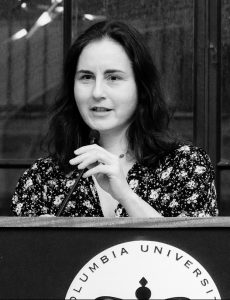
Danielle Spencer (Columbia University)
January 22, 2019, 12-2 p.m. 02-709 Georg-Forster Gebäude
 In this project I “diagnose” a phenomenon I term discovering difference: the experience of newly learning in adulthood that one has a longstanding cognitive or perceptual difference from the norm, particularly one that may be considered pathological. It can occur when the condition has remained undetected, such as becoming aware that one is colorblind, and/or when the diagnostic categories themselves have shifted, as with the emergence of autism spectrum disorders or ADHD. This phenomenon has received relatively scant attention, yet learning of an unknown condition is frequently a significant and bewildering revelation, subverting narrative expectations and customary categories. In addressing the topic I articulate and deploy an evolution of narrative medicine as a robust research methodology comprising interdisciplinarity, narrative attentiveness, and creating a writerly text. Beginning with my own experience of discovering difference, I explore the issues it raises—from communicability to narrative intelligibility to different ways of seeing. Next, I map the phenomenon’s distinctive narrative arc through the stages of recognition, subversion, and renegotiation, and finally discuss this trajectory in light of others’ experiences. I propose that interdisciplinary understanding as well as the figure of blindsight—drawn from my own experience—offers a productive model for negotiating such revelations and for holding different forms of knowledge in generative tension. Better understanding discovering difference will aid those directly affected; moreover, it serves as a bellwether for how we will all navigate advancing biomedical and genomic knowledge, and how we may integrate medico-scientific revelations with what we understand to be our identities.
Danielle Spencer is a faculty member of the Program in Narrative Medicine at Columbia University. She is a co-author of The Principles and Practice of Narrative Medicine (Oxford University Press, 2017) and her work appears in a range of outlets, from Ploughshares to The Lancet. Her research interests include the intersection between narrative, identity, and diagnosis; bioethics and speculative fiction, and healthcare professions pedagogy. Spencer worked as artist/musician David Byrne’s Art Director for many years, collaborating on and exhibiting a range of projects, as well as with photographer Nan Goldin. She holds a B.A. from Yale University and an M.S. in Narrative Medicine from Columbia University, and a Ph.D. des. in American Studies at Johannes Gutenberg University Mainz.
You can download the poster for this talk here.