Lectures, Lunch Lectures, News
Sophia L. Bamert (University of California, Davis)
January 24, 2019, 12-1 p.m., 02.102 (Philo II)
In 1915, sociologist Robert E. Park described the modern city as “a mosaic of little worlds which touch but do not interpenetrate,” a spatial—and racial—imaginary that had already been expressed in Jacob Riis’s portrayal of the Lower East Side as an “extraordinary crazy-quilt” of ethnic immigrant groups in his 1890 exposé How the Other Half Lives and that was reinforced in the 1930s by the Home Owners’ Loan Corporation “redlining” maps. My research considers how the entanglements of geographic imaginaries and material conditions serve to racialize urban space, emphasizing the role of narrative in both upholding and homogenizing geographic representations but also in critiquing those representations by revealing the very narrativity of their construction. I focus on Chicago in the early twentieth century, where the “Chicago School” sociologists taught literature as a window into the urban psyche and interacted with local authors such as Richard Wright. This was, significantly, a moment at which Chicago was America’s most iconic and rapidly growing city, a period during which the intersecting histories of American urbanism, immigration, and the Great Migration also laid the groundwork for the city’s notorious—and still existent—segregation. Bringing together narratology and cultural geography, my talk will theorize the relationship between narrative mapping and racialized space by bringing together turn-of-the century realist novels (Henry Blake Fuller’s The Cliff-Dwellers and Theodore Dreiser’s Sister Carrie) with Chicago Black Renaissance short fiction (Marita Bonner’s Frye Street stories).
Sophia Bamert is a PhD candidate in English with a designated emphasis in Writing, Rhetoric, and Composition Studies at the University of California, Davis. She holds a BA in English and Environmental Studies from Oberlin College and an MA in English from UC Davis. Sophia is currently a visiting lecturer at the Obama Institute for Transnational American Studies at JGU Mainz.
You can download the poster for this talk here.

Exchange Programs, News, Summer School
Apply for the American Studies Summer School 2019!
The Civil Rights Movement, Southern Literature, and Southern Food & Music
Experience a unique and intensive research and learning opportunity focusing on the American South. The Obama Institute offers this three-week American Studies Summer School traveling through Arkansas, Mississippi, Louisiana, Alabama, and Tennessee from the end of July to mid-August. This educational trip provides students with courses in language, literature, and cultural studies. Starting in Little Rock, Arkansas and ending in Washington DC, participants will study the Civil Rights Movement, the history of food and music in the US South, and Southern Literature. They benefit from lectures, readings, and films, as well as on-site learning. Summer School participants can receive course credits in Independent Studies, Cultural Studies, or Written English.
Join our INFO SESSION
Monday, January 21 at 4pm, Room P 11
(Philosophicum)
If you cannot come to the info session, please contact:
Nina Heydt (niheydt@uni-mainz.de) or Julia Velten (juvelten@uni-mainz.de)

News, Workshops
Religious media are part of the knowledge production of faith communities. As producers, disseminators and archivists they play important roles for perpetuating a certain faith tradition. In this workshop, we will analyze how religious journalists and others involved in producing religious online and print media work and thus nourish and support religious affiliation. For this purpose, we will look at three areas of religious journalism: content, technology, and the larger religious network.
Religiöse Medien sind Teil der Wissensproduktion einer Glaubensgemeinschaft. Als Produzenten, Verteiler und Archivare spielen Medien eine wichtige Rolle bei der Erhaltung und Weiterführung einer Glaubenstradition. In diesem Workshop setzen wir uns damit auseinander, wie religiöse Journalisten und andere, die an der Produktion von religiösen online Inhalten und Printmedien beteiligt sind, arbeiten und so religiöse Zugehörigkeit pflegen und unterstützen. Daher werden wir uns mit drei Bereichen des religiösen Journalismus auseinandersetzen: Inhalten, Technologien und dem Netzwerk.
Download the program for the workshop
here.
Events, News
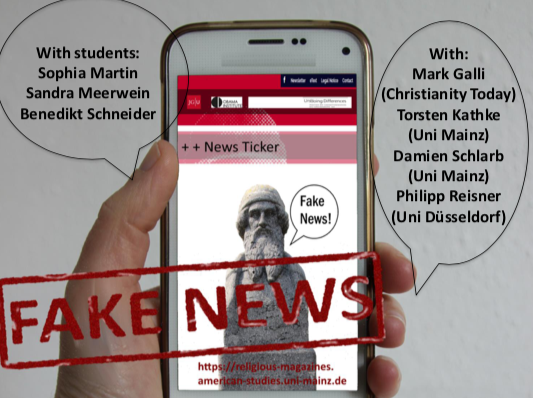
The panel, “Fake News! The Media Debate in the United States,” will take place on January 17, at 6 pm, in the conference room (135) of the Helmholtz Institute, Staudingerweg 19, Johannes Gutenberg University Mainz.
Since “fake news” is an oft-used term in contemporary debate, used to both criticize shortcomings of the information age and employed as an accusation that discredits some media outlets, we want to engage the issue from several perspectives.
The panel will include Mark Galli, the editor in chief of the evangelical Christianity Today (who will be in Mainz for the workshop on religious magazines), who will speak to the question what challenges the “fake news” debate brings to religious journalism and how he and his staff address it. The panel will also include Dr. Philipp Reisner from the University of Düsseldorf – who will provide historical context on the debate, Dr. Torsten Kathke from the University of Mainz – who will discuss the role of social media, and Dr. Damien Schlarb – who will focus on “fake news” as a cultural phenomenon helped along by economic and technological factors. Students Sandra Meerwein, Benedikt Schneider, and Sophia Martin are ready to lead the discussion with questions and examples from today and from history.
You can find the poster for the event
here.Lectures, News
Jutta Zimmermann (Christian-Albrechts-Universitat zu Kiel)
Dec 18, 2018, 9.40-11.10 a.m., Room 328 (Campus Germersheim, FB 06)
In recent years, slavery has been the topic of a whole number of popular literary texts and films. Compared to earlier representations, these latest works are produced within a particular historical and cultural context: the presidency of Barack Obama and the emergence of the Black Lives Matter movement. Whitehead’s novel – but also films like Steve McQueen’s Twelve Years a Slave or Nate Parker’s The Birth of a Nation – respond to and negotiate between competing claims about race relations in the U.S.: Is the first black president an indication that racism has been overcome? Or, has slavery never come to an end and persists in the present? In order to answer these questions, the presentation will make an attempt to trace the role that slavery has played in African American culture since the 1960s.
You can find the poster for the event here.
Lectures, Lunch Lectures, News
Vanessa Evans (York University, Canada)
December 13, 2018, 12-1 p.m., 02.102 (Philo II)
Too often, the pull of the policy audience has resulted in decolonization being enlisted as a hollow metaphor that seeks to reconcile settler complicity and secure settler futurity. This seduction has immense consequences for the substance, style, and politics of research in Indigenous studies. As such, the field of Indigenous literary study cannot blindly adopt the agendas of those making or administering policy. I advocate that a primary impediment to an increased consciousness about Indigeneity lies in how we study the contemporary literature of Indigenous peoples. This requires a reconceptualization of Indigeneity away from its boundedness to specific lands and pasts that valorize ties to first contact, instead embracing the reality that Indigenous peoples are a contemporary presence throughout the world. In response to this reimagining, my research investigates: (i) how the study of Indigenous world literatures might destabilize characterizations of absence that isolate Indigenous peoples to particular places and pasts, and (ii) how these literatures can entrench Indigenous presence as planetary phenomenon. I make this intervention by modeling a cosmic methodology that recognizes Indigeneity and Indigenous peoples as omnipresent and thriving; it is, at its heart, a project that contributes to the ongoing work of decolonizing literary study itself through the minds of those who study and teach literature.
Vanessa Evans is a doctoral candidate in the Department of English at York University. She holds a B.A. in English from the University of Calgary and an M.Litt. in Modernities from the University of Glasgow. Vanessa is currently a visiting lecturer at the Obama Institute for Transnational American Studies at JGU Mainz.
You can download the poster for this talk here.